HomeRomeRome Layered: Two Thousand Years in Three Hours
Rome Layered: Two Thousand Years in Three Hours
Rome · Walking Tour

Rome Layered: Two Thousand Years in Three Hours

2 hrsWalk
1.9 kmDistance
7Stops
28Chapters

About this route

Step into Piazza di Spagna where Grand Tour aristocrats once lounged on travertine, then follow the ancient Aqua Virgo's path to the Trevi Fountain's Baroque spectacle, press through the illusions of Sant'Ignazio and the living columns of Hadrian's temple, stand before the Pantheon's 1,900-year-old dome, cross the footprint of Domitian's stadium at Piazza Navona, and arrive at Campo de' Fiori — where a hooded bronze philosopher watches the morning market from the spot where the Church burned him alive in 1600.

🎧 Narrated audio tour⬇️ Works offline🌐 English📍 7 stops
Narrated by
rrawi
English

Stops on the route

7 stops · 28 chapters
Spanish Steps
01

Spanish Steps

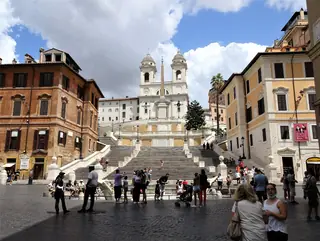
The Spanish Steps open the tour as Rome's original international crossroads — a monument born from Franco-papal rivalry, finished in 1725, and immediately…

~10 min here·4 chapters
Why Two Flags Are Hidden in the StoneFree chapter

The Spanish Steps were the product of a decades-long tug-of-war between French patrons and papal Rome — and that tension is literally carved into the monument.

0:000:00
The Competition That Nearly Wasn'tFree chapter

A formal design competition in 1717 finally broke the deadlock, and the winner wasn't who anyone expected.

0:000:00
Reading the Symbols Above You Right Now

The decorative program of the steps encodes the Franco-papal compromise that made the project possible — visible today in the stonework.
🔓
Unlock 1 more chapters in the app
Get the app
Trevi Fountain
02

Trevi Fountain

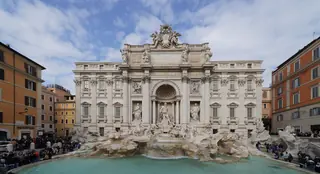
The Trevi Fountain layers two thousand years of Roman engineering into one Baroque spectacle — the same aqueduct Marcus Agrippa ordered built in 19 BC still…

~20 min here·4 chapters
The Roman Who Never Saw His Masterpiece

Nicola Salvi won the commission for the Trevi Fountain through a public controversy over a Florentine rival, devoted nearly two decades to it, and died eleven years before it was completed.

The Aqueduct That Started 2,000 Years Ago

The water powering the Trevi Fountain today flows through a system begun by Marcus Agrippa in 19 BC — making the fountain the end point of nearly 2,000 years of continuous water infrastructure.

What Baroque Architects Did With a Palace Wall

The Trevi Fountain was deliberately built into the facade of Palazzo Poli, turning the building itself into a stage set — a defining trick of Baroque design that makes the fountain feel like a theatrical performance rather than a standalone monument.

🔓
Unlock 1 more chapters in the app
Get the app
Chiesa di Sant'Ignazio di Loyola
03

Chiesa di Sant'Ignazio di Loyola

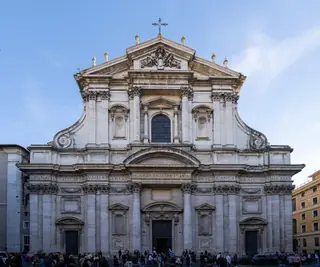
Andrea Pozzo's breathtaking trompe-l'œil ceiling and painted false dome make Sant'Ignazio the tour's most legible demonstration of Counter-Reformation…

~20 min here·2 chapters
The Jesuit Mission Painted Into the Sky

Sant'Ignazio began as the chapel of Rome's most powerful Jesuit college, and its ceiling fresco turns that institutional mission into a visual argument spanning the four continents.

The Dome That Was Never Built

A flat canvas painted by Pozzo simulates a dome the Jesuits could never afford to construct — and from the right spot, it's nearly impossible to tell.

Temple of Hadrian / Piazza di Pietra
04

Temple of Hadrian / Piazza di Pietra

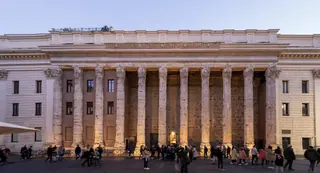
Eleven marble columns from a temple dedicated in 145 CE now serve as the facade of a 19th-century financial institution, making Piazza di Pietra one of the…

~15 min here·2 chapters
A Temple Hiding in Plain Sight

The Temple of Hadrian was dedicated in 145 CE by Antoninus Pius to honor his deified predecessor, and eleven of its original fifteen columns still stand along the northern side of the piazza.

When a Temple Became a Stock Exchange

In 1879, architect Virginio Vespignani incorporated the ancient remains into a new building for the Stock Exchange and Chamber of Commerce — a defining example of Rome's habit of reusing its own past.

Pantheon
05

Pantheon

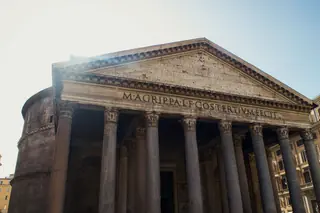
The Pantheon is the tour's clearest proof of Rome's genius for repurposing its own past — a temple built by Hadrian under Agrippa's name, converted to a church…

~20 min here·6 chapters
The Emperor Who Erased His Own Name

Hadrian rebuilt the Pantheon entirely but kept his predecessor's inscription on the facade — an act of deliberate self-erasure that is still visible from where you stand today.

Sixteen Columns, Sixty Tons Each, Shipped From Egypt

The sixteen granite columns of the portico are each a single piece of stone, 11.9 meters tall and weighing roughly 60 tons, quarried in Egypt and transported to Rome — a feat of logistics that staggers the imagination even by modern standards.

The Dome That Shouldn't Be Possible

The Pantheon's dome is 43.3 meters in diameter — exactly equal to its height above the floor — forming a perfect sphere; its unreinforced concrete grows progressively lighter toward the top, a feat of engineering that kept it standing for nearly 1,900 years.

🔓
Unlock 3 more chapters in the app
Get the app
Piazza Navona
06

Piazza Navona

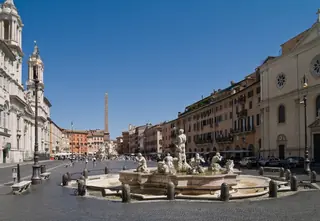
Domitian's ancient stadium never disappeared — it became a medieval neighborhood, then a Baroque family monument, and its outline is still the shape of the…

~10 min here·5 chapters
The Roman Stadium Hidden in Plain Sight

Piazza Navona's distinctive elongated shape is not a design choice — it is the direct footprint of a Roman athletic stadium built nearly 2,000 years ago.

From Stadium to Medieval Neighbourhood

After the stadium fell out of use, Romans built directly into and over its structure, turning the arena floor into a street and its arched substructures into homes and workshops.

One Pope, One Family, One Square

In the mid-17th century, Pope Innocent X transformed Piazza Navona into a Baroque showcase for his own family, the Pamphilj, commissioning the fountain, the church, and the palace that still define the square.

🔓
Unlock 2 more chapters in the app
Get the app
Campo de' Fiori
07

Campo de' Fiori

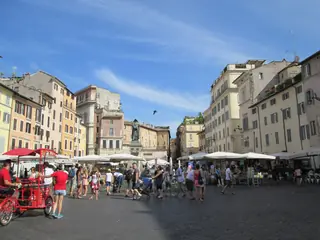
The tour's final stop strips away papal grandeur and Baroque spectacle to reveal Rome at street level — a working market square whose surrounding lanes still…

~8 min here·5 chapters
The Square That Was Never Meant to Impress

Campo de' Fiori is the only major Roman square that was never given a formal architectural design — and that informality is exactly the point.

The Borgia Family's Neighborhood Inn

Vannozza dei Cattanei — the long-term partner of the man who became Pope Alexander VI — owned the square's most prominent inn, and her family arms are still on the façade today.

The Man Who Refused to Take It Back

On February 17, 1600, Giordano Bruno — philosopher, former friar, and relentless intellectual — was burned alive on this exact spot after refusing to fully recant his ideas before the Roman Inquisition.

🔓
Unlock 2 more chapters in the app
Get the app

FAQ

How long does this route take?

The audio narration is 48:11 in total. If you pause to look around and take photos, budget 2 hrs. You can pause and resume any time — including the next day.

Is the tour narrated in my language?

This version is narrated in English by rrawi. Other language versions may be available — check the language switcher on this page.

Can I listen without an internet connection?

Yes. This self-guided audio tour works fully offline — download it in the rrawi app before you set off, and GPS automatically triggers the next chapter as you walk. No signal needed.

Do I have to start from the first stop?

No — you can start or jump to any stop in the app. The route works in order, but each stop stands on its own if you need to skip.

What does the free part include?

Different tours offer different free preview chapters depending on the content. Download the rrawi app and subscribe to a City Pass to unlock all 28 chapters and experience the full route.

Ready to walk Rome?

Download rrawi and let rrawi walk with you.

Walk with the app
First chapter at each stop is free
Get the app