HomeRomeFrom Emperor's Tomb to Papal Throne: Rome's Sacred Mile · 1 Day
Rome · Walking Tour

From Emperor's Tomb to Papal Throne: Rome's Sacred Mile · 1 Day

7 hrsWalk
3.1 kmDistance
6Stops
25Chapters

About this route

Imagine standing inside an emperor's mausoleum that became a pope's fortress, then crossing Hadrian's own bridge — now lined with Bernini's angels — past the very scaffold where Beatrice Cenci was beheaded, down a boulevard Mussolini bulldozed into existence to celebrate a treaty that ended sixty years of war between Italy and the Church, and finally into St. Peter's Square, where a colonnade designed as the arms of God embraces the same obelisk that once watched Peter's execution, leading at last into a basilica whose construction costs ignited the Reformation and whose greatest dome was designed by a seventy-two-year-old sculptor who never saw it built.

🎧 Narrated audio tour⬇️ Works offline🌐 English📍 6 stops
Narrated by
rrawi
English

Stops on the route

6 stops · 25 chapters
Castel Sant'Angelo
01

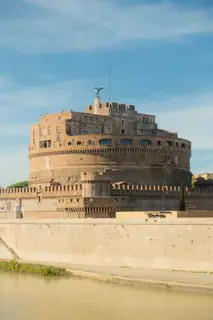
Castel Sant'Angelo

The tour opens here because Hadrian's mausoleum-turned-papal-fortress is the most vivid single monument to the tour's central story: how Christian Rome…

~2 hrs here·5 chapters
The Emperor Who Built His Own EternityFree chapter

Hadrian commissioned this cylindrical mausoleum as a dynastic burial monument, completed in 139 AD — one of the most ambitious building projects of the Roman Empire.

0:000:00
What the Spiral Ramp Reveals InsideFree chapter

The internal spiral ramp leading to the burial chamber is a feat of Roman engineering still visible today, and it tells you how seriously Hadrian took the idea of an eternal monument.

0:000:00
How a Tomb Became a Fortress

The mausoleum was converted into a military fortress by the late Roman period and later became the primary refuge of the medieval and Renaissance papacy, illustrating how Christian Rome literally occupied the infrastructure of imperial Rome.
🔓
Unlock 2 more chapters in the app
Get the app
Ponte Sant'Angelo
02

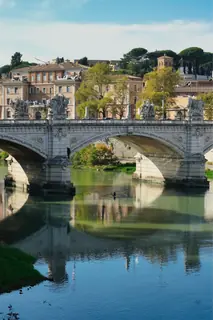
Ponte Sant'Angelo

Hadrian's bridge, transformed by Bernini's angels into a devotional pilgrim runway, carries the story from imperial infrastructure to sacred threshold — and…

~20 min here·4 chapters
A Roman Bridge With an Unanswered Question

The Ponte Sant'Angelo began as a purely imperial Roman structure — Hadrian's private road to his own tomb — and its original ancient bones still carry you across the Tiber today.

How a Tomb Became a Fortress and a Bridge Became a Road to God

Over centuries, the mausoleum transformed into a papal fortress and the bridge in front of it became the primary pilgrimage route into St. Peter's, fundamentally changing what the crossing meant.

Bernini's Angels and the Instruments of the Passion

Pope Clement IX commissioned Bernini in 1669 to redesign the bridge with ten marble angels, each bearing one of the instruments of Christ's Passion, turning the crossing into a sculptural pilgrimage experience.

🔓
Unlock 1 more chapters in the app
Get the app
Via della Conciliazione
03

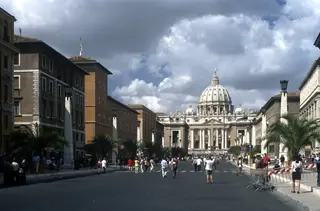
Via della Conciliazione

The avenue Mussolini carved through a medieval neighborhood to celebrate the Lateran Treaty makes the Church-state reconciliation literally visible in stone…

~20 min here·2 chapters
The Treaty That Named This Street

The Lateran Treaty of 1929 ended a 59-year standoff between the Catholic Church and the Italian state, and Via della Conciliazione was literally named after that reconciliation.

What Mussolini Demolished to Build His Vision

To create Via della Conciliazione, Mussolini's architects demolished the Spina di Borgo — a dense medieval neighborhood — fundamentally changing how visitors approach and experience St. Peter's.

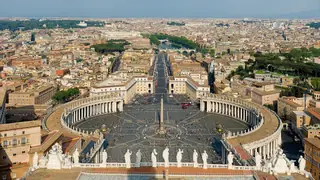
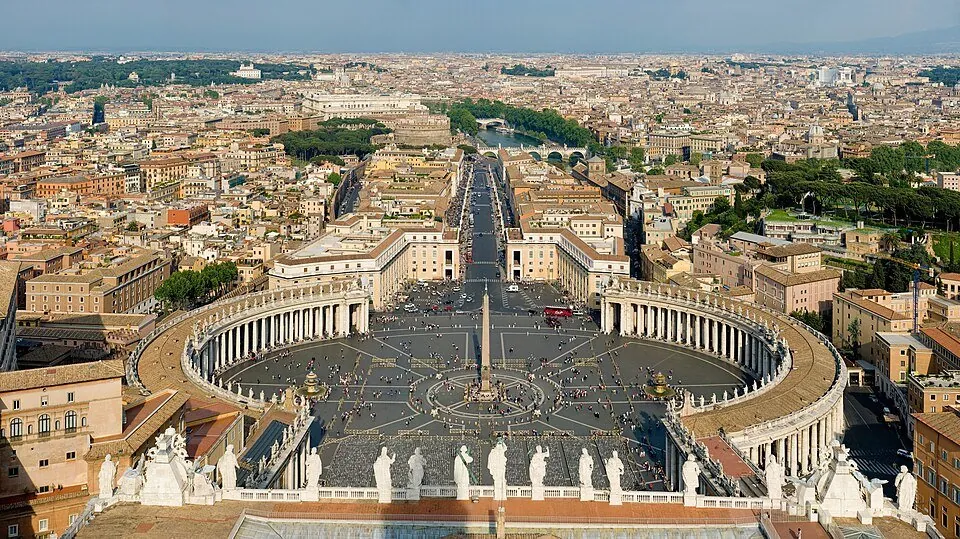
St. Peter's Square
04

St. Peter's Square

Bernini's colonnades — the Church's arms reaching out to embrace the world — and the obelisk that witnessed Peter's execution together make the square the…

~40 min here·2 chapters
The Obelisk That Outlived Two Empires

The Vatican obelisk predates Christianity entirely — it stood in the Circus of Caligula and Nero before being moved to its current position in 1586, making it the oldest object in the square and a symbol of Rome absorbing the ancient world into Christian identity.

Bernini's Arms Around the World

Bernini designed the colonnades between 1656 and 1667 as a deliberate architectural metaphor — the Church physically embracing all of humanity — while solving a practical problem of scale for Pope Alexander VII.

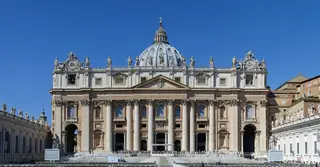
St. Peter's Basilica
05

St. Peter's Basilica

The basilica built over Peter's tomb, whose 120-year construction triggered the Reformation, concentrates every thread of the tour — Constantine, Michelangelo,…

~2 hrs here·7 chapters
Why a Fisherman's Tomb Became This

St. Peter's Basilica stands on this spot because early Christians believed Peter — the fisherman Jesus called "the rock" — was buried exactly here, and that belief has driven every layer of building on this site for nearly two thousand years.

Constantine Builds Over the Tomb

The first great basilica on this site was built by the Emperor Constantine in the early 4th century, directly over what Christians already venerated as Peter's grave — a deliberate act of imperial endorsement of the new faith.

Bramante's Vision and Its Price

Donato Bramante designed a revolutionary centralized Greek-cross plan for the new basilica, but his demolition of the old church destroyed irreplaceable medieval art and tombs — earning him the nickname "Master Wrecker."

🔓
Unlock 4 more chapters in the app
Get the app
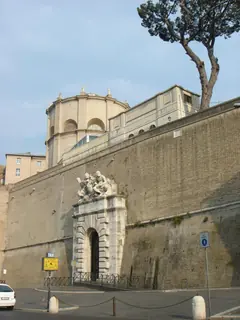
Vatican Museums
06

Vatican Museums

The papal collections, born from Julius II's impulsive purchase of the Laocoön and expanded over centuries, show how the same popes who built St. Peter's used…

~2 hrs here·5 chapters
One Pope, One Morning, One Museum Born

The Vatican Museums trace their origin to a single acquisition in 1506, when Pope Julius II purchased the freshly excavated Laocoön and put it on public display — establishing the principle that the papacy would collect and show great art.

From Private Collection to Public Museum

What began as a papal sculpture garden evolved over centuries into a federation of distinct museums — the institution visitors walk through today is not one museum but many, layered across five hundred years.

Julius II's Other Obsession: Decorating the Apartments

Julius II commissioned Raphael — a 25-year-old from Urbino — to paint his private papal apartments, producing the four Raphael Rooms, including the School of Athens, one of the High Renaissance's defining images.

🔓
Unlock 2 more chapters in the app
Get the app

FAQ

How long does this route take?

The audio narration is 47:01 in total. If you pause to look around and take photos, budget 7 hrs. You can pause and resume any time — including the next day.

Is the tour narrated in my language?

This version is narrated in English by rrawi. Other language versions may be available — check the language switcher on this page.

Can I listen without an internet connection?

Yes. Download the tour in the rrawi app before you set off and it plays fully offline — no signal needed while you walk.

Do I have to start from the first stop?

No — you can start or jump to any stop in the app. The route works in order, but each stop stands on its own if you need to skip.

What does the free part include?

Different tours offer different free preview chapters depending on the content. Download the rrawi app and subscribe to a City Pass to unlock all 25 chapters and experience the full route.

Ready to walk Rome?

Download rrawi and let rrawi walk with you.

Walk with the app
First chapter at each stop is free
Get the app