Home › Rome › Caesar’s Death: Why the Republic Stayed Dead
Caesar’s Death: Why the Republic Stayed Dead
Rome · Walking Tour

Caesar’s Death: Why the Republic Stayed Dead

4 hrsWalk
1.2 kmDistance
7Stops
25Chapters

About this route

Imagine killing Rome’s most powerful man only to discover that his power survives him, from Pompey’s theatre footprint through the Curia of Pompey and Caesar’s own forum to the Temple of Divine Julius, where Augustus dedicated a shrine to the deified Caesar in 29 BC.

🎧 Narrated audio tour⬇️ Works offline🌐 English📍 7 stops
Narrated by
rrawi
English

Stops on the route

7 stops · 25 chapters
01

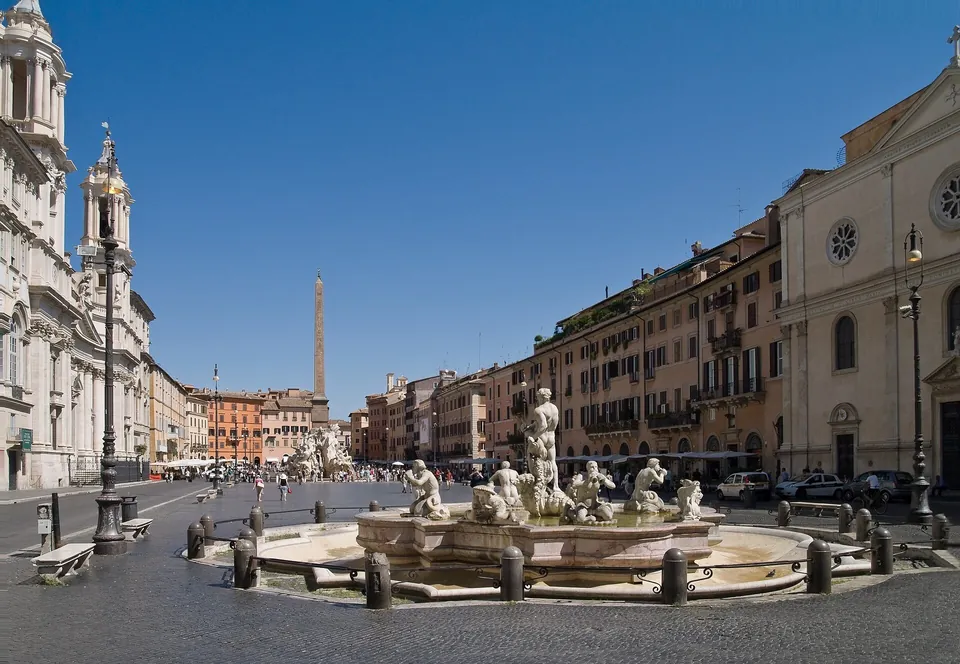
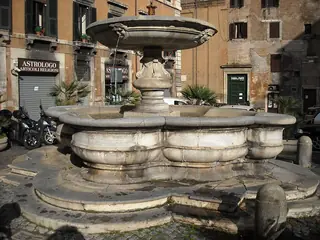
Theatre of Pompey and Via di Grotta Pinta

The curved street preserves the urban imprint of Pompey’s monumental ambition and opens the story of how Caesar and Pompey moved from partners to enemies.

~20 min here·3 chapters
Whose Street Is This, Really?Free chapter

The curved alignment of Via di Grotta Pinta is an urban trace of Pompey's theatre — the first permanent stone theatre in Rome — not exposed ancient seating, and the buildings standing here rest on its foundations.

0:000:00
Partners, Then Enemies — How the Alliance BrokeFree chapter

Caesar and Pompey began as political partners but became opponents in a civil war that ended at Pharsalus, where Caesar's victory left him without a rival — and without a check on his power.

0:000:00
What This Complex Was — and Where the Murder Actually Happened

The theatre was one end of a much larger complex; Pompey's meeting hall — where Caesar was killed — stood at the opposite end, near what is now Largo Argentina, not here on Via di Grotta Pinta.
largo-di-torre-argentina
02

largo-di-torre-argentina

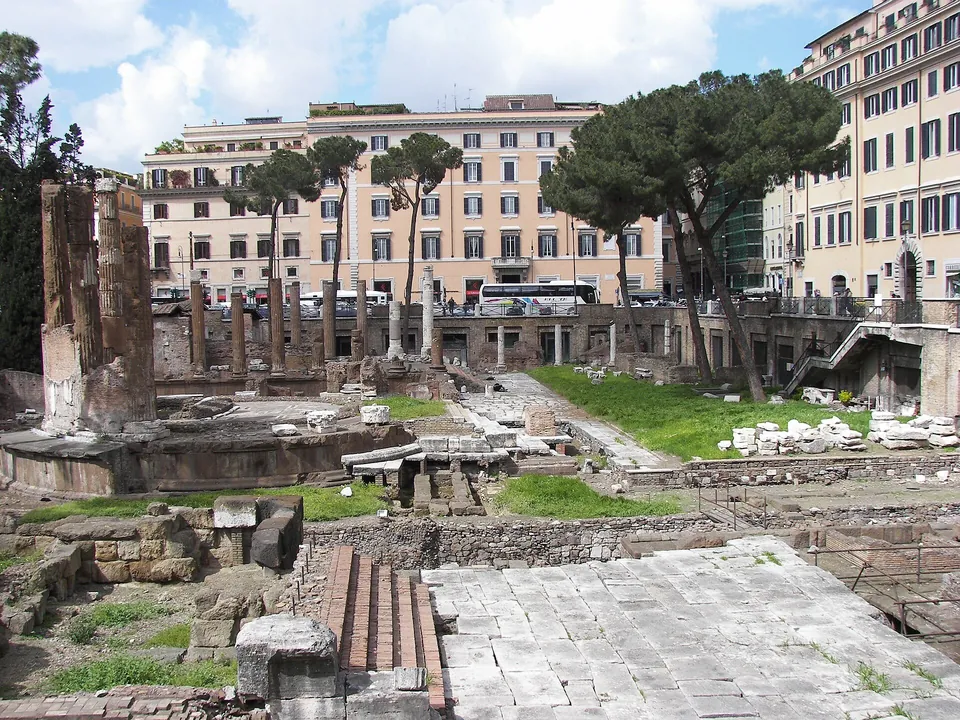
Here the traces of the Curia of Pompey locate Caesar’s assassination and expose why killing the dictator did not restore stable Republican government.

~30 min here·5 chapters
What Stood Here Before the Murder

The four Republican temples at Largo Argentina predate Caesar's death by centuries, built in successive phases of the Roman Republic.

Pompey's Shadow Over This Ground

The Curia of Pompey — a rectangular hall where the Senate occasionally met — was part of Pompey's portico complex adjoining the temple area, not one of the temples themselves.

The Dictator for Life and His Enemies

Caesar had accepted the office of dictator for life — an unprecedented concentration of power that drove the conspiracy led by Cassius, Marcus Brutus, and Decimus Brutus.

🔓
Unlock 2 more chapters in the app
Get the app →
03

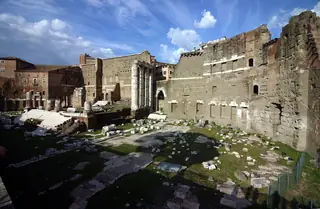
Forum of Caesar

Caesar’s forum reveals how military success, divine ancestry, and personal monument-building pressed against the conventions of Republican government.

~25 min here·3 chapters
Caesar's Monument to Himself — and His Goddess

The Forum of Caesar was a personal political statement built before the civil war was even won, anchoring Caesar's power in a claim of divine ancestry.

The Man Who Wouldn't Stand Up

Suetonius records that Caesar received senators at this temple without rising — a gesture that crystallized why the Senate feared him.

What You're Actually Looking At Today

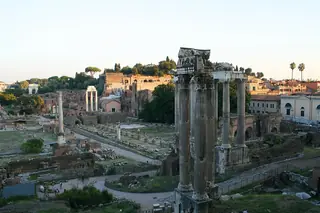
The three visible columns are a 1933 re-erection of Trajanic stonework, not an untouched Caesarian structure — and modern excavation is what made the whole site readable again.

Roman Forum-Palatine Archaeological Area
04

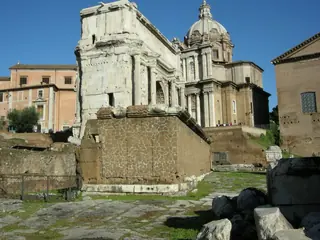
Roman Forum-Palatine Archaeological Area

This selected orientation stop establishes the Forum’s layered civic landscape before the Senate house, speaking platform, and Caesar’s temple each take up…

~3 hrs here·3 chapters
What This Valley Was Before Rome Ruled It

The Roman Forum began as a marshy valley that was drained and gradually built up into Rome's civic heart over many centuries.

One Landscape, Many Kinds of Power

The Forum held political, religious, commercial, and judicial functions simultaneously — and the coexistence of these institutions in one space did not mean power was equally shared between them.

What Survived, and Why That's Not Random

The Forum's surviving monuments reflect later reuse and centuries of excavation as much as ancient importance — the buildings still standing often survived because they were converted to churches or other uses.

Curia Julia
05

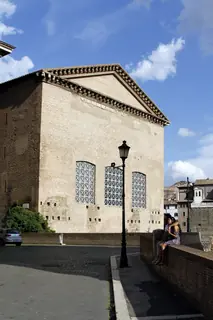
Curia Julia

Inside Roman Forum

This essential stop shows how Caesar physically reorganized the Senate house and how the institution’s shell survived after Republican power had shifted…

~20 min here·4 chapters
What Caesar Actually Built Here

The Curia Julia was Caesar's Senate house project — he reorganised the institution and reoriented the building, though it was completed only after his death.

The Assassination Did Not Happen Here

Caesar was killed in Pompey's Curia, not in this building — a distinction that matters for understanding both the geography of the Forum and the politics of the moment.

Inside the Hall Where Senators Sat

The interior arrangement — senators on broad low steps along both walls — reveals how the Senate actually functioned as a deliberative body.

🔓
Unlock 1 more chapters in the app
Get the app →
Rostra
06

Rostra

Inside Roman Forum

This essential platform shows how Caesar’s funeral mobilized the crowd and how the later display of Cicero’s remains turned public speech into political terror.

~10 min here·4 chapters
What the Rostra Was Built to Do

The Rostra was Rome's premier public speaking platform, designed so that a speaker's voice and body could command the entire open Forum square — the ancient city's most powerful stage.

Caesar's Redesign and the Platform You See Today

Caesar planned to relocate and rebuild the Rostra as part of his reorganization of the Forum; his successor completed it — and much of the current form is actually early twentieth-century restoration.

The Funeral, the Speech, and the Fire That Followed

Ancient accounts place Caesar's funeral in the Forum, with Antony's address to the crowd from this platform — the speech that turned grief into fury and ignited civil war.

🔓
Unlock 1 more chapters in the app
Get the app →
Temple of Divine Julius Caesar
07

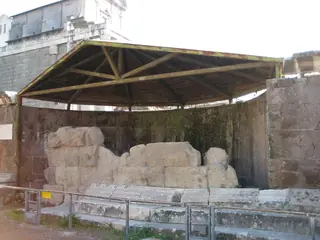
Temple of Divine Julius Caesar

Inside Roman Forum

This indispensable final stop brings together Caesar’s funeral, deification, and contested inheritance to show concretely why assassination restored nothing.

~10 min here·3 chapters
What the Niche in the Ground Actually Marks

The surviving remains — a low platform with a recessed semicircular niche and altar — mark the place of Caesar's funeral pyre, not his assassination, and what you see today does not represent the full height of the ancient temple.

The Night the Forum Became a Funeral Pyre

According to Suetonius, the Roman crowd burned Caesar's body in the Forum itself after the funeral ceremony, a spontaneous act that transformed the site into a place of popular veneration.

Who Built This Temple, and Why

The temple was begun in 42 BC and dedicated by Augustus in 29 BC — not as an act of pure piety, but as a political claim: the heir of a god had now won the civil wars and stood alone.

FAQ

How long does this route take?

The audio narration is 45:28 in total. If you pause to look around and take photos, budget 4 hrs. You can pause and resume any time — including the next day.

Is the tour narrated in my language?

This version is narrated in English by rrawi. Other language versions may be available — check the language switcher on this page.

Can I listen without an internet connection?

Yes. This self-guided audio tour works fully offline — download it in the rrawi app before you set off, and GPS automatically triggers the next chapter as you walk. No signal needed.

Do I have to start from the first stop?

No — you can start or jump to any stop in the app. The route works in order, but each stop stands on its own if you need to skip.

What does the free part include?

Preview the tour’s first two chapters at the first stop for free. Download the rrawi app and purchase the tour to unlock all 25 chapters and follow the full route.

Ready to walk Rome?

Download rrawi and let rrawi walk with you.

Walk with the app
Preview the tour’s first two chapters free
Get the app