HomeRomeOne Ordinary Day in Imperial Rome
Rome · Walking Tour

One Ordinary Day in Imperial Rome

4 hrsWalk
3.4 kmDistance
6Stops
23Chapters

About this route

Imagine surviving one ordinary day in imperial Rome, from a cramped upper-floor home at the Insula dell'Ara Coeli through the working economy of Trajan's Markets and the patronage networks of the Forum of Augustus to the roaring Circus Maximus and the Baths of Caracalla, where leisure above depends on enslaved crews feeding furnaces below.

🎧 Narrated audio tour⬇️ Works offline🌐 English📍 6 stops
Narrated by
rrawi
English

Stops on the route

6 stops · 23 chapters
Insula dell'Ara Coeli
01

Insula dell'Ara Coeli

This exceptionally preserved apartment block begins the day with the realities of rent, water, noise, social hierarchy, and the constant dangers of fire and…

~15 min here·3 chapters
What Rome Looked Like From the Bottom UpFree chapter

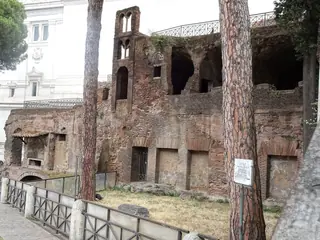
The Insula dell'Ara Coeli is a rare surviving example of the multi-storey apartment blocks that housed most of Rome's urban population, and its ancient street level — far below the modern city — makes Rome's accumulated historical layers physically visible.

0:000:00
Life Inside a Roman Apartment BlockFree chapter

Roman insulae were vertically stratified by class — ground-floor spaces were commercial and desirable, while upper floors were smaller, cheaper, and far more dangerous.

0:000:00
How the Building Outlasted the Empire

The Insula dell'Ara Coeli was continuously reused across centuries — medieval structures were inserted directly into the Roman fabric, showing the building's long life well beyond antiquity.
Mercati di Traiano (Trajan's Markets)
02

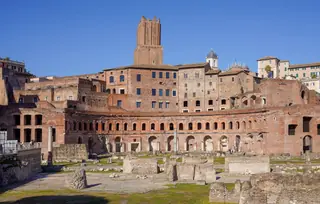
Mercati di Traiano (Trajan's Markets)

Trajan's Markets carries our resident into Rome's morning economy of shops, craftspeople, merchants, clerks, and imperial administration.

~45 min here·3 chapters
Two Men Who Built This Place

Trajan's Markets were built with Dacian war spoils, but the engineering genius behind them belonged to Apollodorus of Damascus — and their relationship with power ended very differently.

What a Roman Morning Looked Like Here

The Markets functioned as a commercial and administrative hub where ordinary Romans shopped, worked, and conducted business from early morning.

The Architect and the Emperor Who Came After

The disputed story of Apollodorus and Hadrian shows how personal relationships — and personal slights — could determine a man's fate even at the top of the Roman world.

Forum of Augustus
03

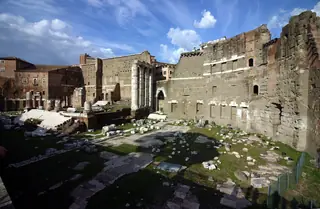
Forum of Augustus

The Forum of Augustus places introductions, contracts, lawsuits, and patronage inside an imperial setting that reveals how personal connections shaped a Roman…

~30 min here·3 chapters
A Vow Made Before a Battle

The Forum of Augustus was born from a promise made on a battlefield — Augustus vowed to build a temple to Mars the Avenger if he won at Philippi, and the completed forum, dedicated in 2 BC, turned that personal vow into permanent stone.

The Morning Your Connections Were Everything

The Forum of Augustus served as a hub for legal business, political networking, and the patron-client system that structured Roman social life — its architecture was deliberately designed to reinforce Augustus's authority over all of it.

The Wall That Kept Two Worlds Apart

The massive firewall at the forum's edge was both a practical fire barrier separating the marble complex from the crowded Subura neighborhood and a deliberate architectural statement about the boundary between Augustan order and urban chaos.

Temple of Hercules Victor
04

Temple of Hercules Victor

The Temple of Hercules Victor adds the religious dimension of commerce in the Forum Boarium, where river goods, olive oil, and mercantile ambition met divine…

~10 min here·4 chapters
The Round Temple Among the Noise

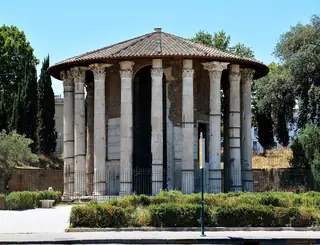
The Temple of Hercules Victor is a Greek-style circular peripteral temple — a tholos — that stands in the Forum Boarium, Rome's ancient cattle and river market.

The Geometry of Nineteen Columns

The temple originally had twenty Corinthian columns forming its ring; nineteen survive today, standing 10.66 metres tall on a tuff foundation, encircling a cella 14.8 metres in diameter.

Who Built It — and Why Hercules?

The temple's patron is disputed between two figures — L. Mummius Achaicus and a merchant named Marcus Octavius Herrenus — and its dedication connects to Hercules's role as a god of trade in the Forum Boarium.

🔓
Unlock 1 more chapters in the app
Get the app
Circus Maximus
05

Circus Maximus

The Circus Maximus turns afternoon entertainment into mass identity through 150,000 spectators, faction rivalries, betting, and celebrity charioteers.

~20 min here·5 chapters
The Valley Before the Roar Began

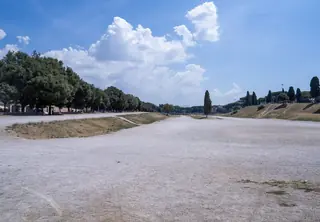
The Circus Maximus grew from a natural valley used for early festivals into Rome's greatest venue across centuries of rebuilding.

What Race Day Looked Like at Full Roar

The Circus Maximus was a precisely engineered racing machine, from its twelve spring-loaded starting gates to the lap-counting monuments on the central barrier.

The Four Factions and Their Fanatics

Chariot racing was organized into four color-coded factions — Blues, Greens, Reds, and Whites — that commanded fierce loyalty comparable to modern sports tribalism.

🔓
Unlock 2 more chapters in the app
Get the app
Baths of Caracalla
06

Baths of Caracalla

The Baths of Caracalla bring bathing, exercise, gardens, gossip, and deal-making together as the social climax of an ordinary Roman afternoon.

~45 min here·5 chapters
What the Baths Were Built to Be

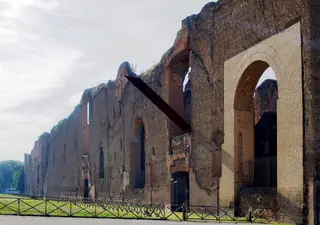
The Baths of Caracalla were Rome's second-largest bath complex, designed for roughly 1,600 simultaneous visitors and packed with amenities far beyond bathing.

The Engineering Keeping It All Running

The baths required extraordinary infrastructure — underground tunnels, aqueduct-fed cisterns, and furnaces burning roughly ten tons of wood per day — to maintain heat and water for thousands of visitors.

What the Interior Actually Looked Like

The baths' interiors were covered in colored marble, mosaic floors, monumental columns, and colossal sculpture — a deliberate display of imperial wealth that shaped how visitors experienced the space.

🔓
Unlock 2 more chapters in the app
Get the app

FAQ

How long does this route take?

The audio narration is 43:51 in total. If you pause to look around and take photos, budget 4 hrs. You can pause and resume any time — including the next day.

Is the tour narrated in my language?

This version is narrated in English by rrawi. Other language versions may be available — check the language switcher on this page.

Can I listen without an internet connection?

Yes. This self-guided audio tour works fully offline — download it in the rrawi app before you set off, and GPS automatically triggers the next chapter as you walk. No signal needed.

Do I have to start from the first stop?

No — you can start or jump to any stop in the app. The route works in order, but each stop stands on its own if you need to skip.

What does the free part include?

Different tours offer different free preview chapters depending on the content. Download the rrawi app and subscribe to a City Pass to unlock all 23 chapters and experience the full route.

Ready to walk Rome?

Download rrawi and let rrawi walk with you.

Walk with the app
First chapter at each stop is free
Get the app