Home › Luxor › Medinet Habu: Power, Ritual, and Reuse
Medinet Habu: Power, Ritual, and Reuse
Luxor · Walking Tour

Medinet Habu: Power, Ritual, and Reuse

2 hrsWalk
0.0 kmDistance
6Stops
15Chapters

About this route

Imagine entering a walled city where every threshold changes the king’s identity—from the Migdol Gate’s intimidating public face, through the First Court’s palace stage and the Second Court’s festival hall turned church, to the inner sanctuary where a genuine barque pedestal emerged from a pit beside Amun’s room.

🎧 Narrated audio tour⬇️ Works offline🌐 English📍 6 stops
Narrated by
rrawi
English

Stops on the route

6 stops · 15 chapters
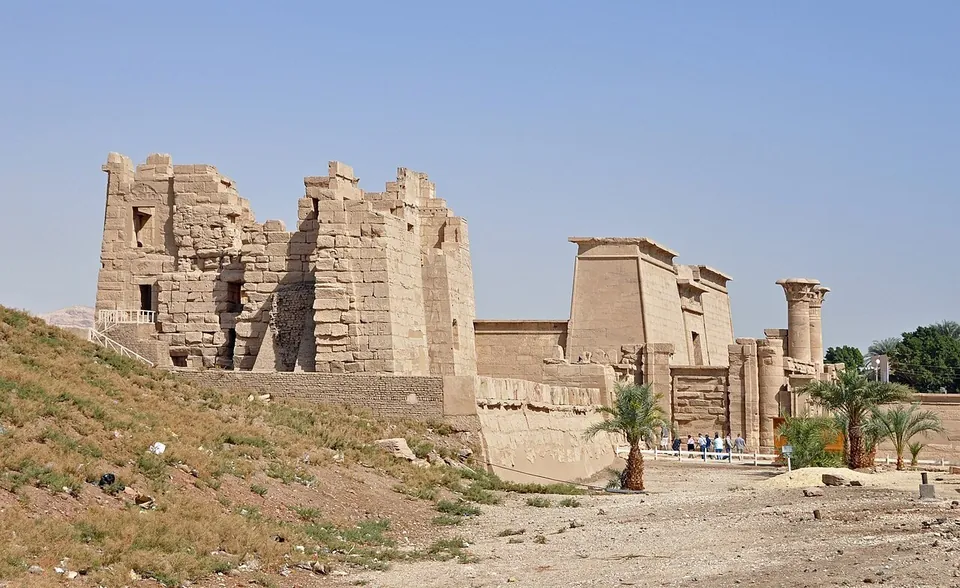
Medinet Habu Temple Complex
01

Medinet Habu Temple Complex

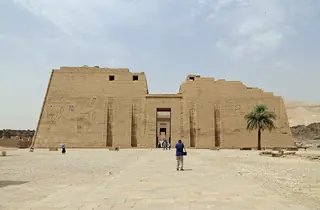
Selected as the essential orientation stop, this compound view separates the mortuary temple, palace, courts, and older shrine before their stories unfold…

~2 hrs here·5 chapters
One Site, Surprisingly Many BuildingsFree chapter

Medinet Habu is not a single temple but a walled compound containing a mortuary temple, a royal palace, courts, shrines, and an older sacred building — all serving distinct purposes.

0:000:00
The King Who Built This — and Who His Father Really WasFree chapter

Ramesses III, son of Setnakht — the founder of the Twentieth Dynasty — built this as his mortuary establishment during a reign of 32 years in the New Kingdom.

0:000:00
A Temple Older Than the King Who Surrounded It

An Eighteenth Dynasty shrine — built around 1460 BCE under Hatshepsut and Thutmose III — already stood on this ground and was deliberately incorporated into Ramesses III's later enclosure, then extended again by Kushite, Ptolemaic, and Roman builders.
🔓
Unlock 2 more chapters in the app
Get the app →
Migdol Gate
02

Migdol Gate

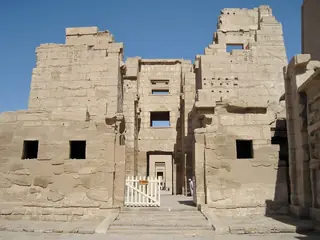
Essential as the first threshold where aggressive royal imagery outside contrasts with the private royal rooms above.

~15 min here·2 chapters
The Face the Gate Shows the World

The Migdol Gate's east facade presents aggressive royal protection imagery — a king smiting enemies — designed to control both access and perception at the compound's entrance.

What the Upper Rooms Actually Contained

Above the intimidating exterior, the Migdol Gate's upper floors held royal rooms decorated with leisure scenes — a programme entirely distinct from the martial imagery below, though the wooden floor divisions that once separated these spaces are now lost.

First Pylon and Battle Reliefs
03

First Pylon and Battle Reliefs

Essential for distinguishing the pylon’s timeless formula of royal victory from the politically shaped campaign narratives on the outer north wall.

~15 min here·2 chapters
What the Pylon Was Built to Say

The first pylon's facade presents a timeless, symbolic image of royal triumph — not a historical account — with large smiting scenes designed to frame every entry into the temple as a moment of cosmic order restored.

Where the Actual Campaigns Get Told

The outer north wall — a completely separate surface from the pylon facade — carries sequential narrative battle scenes, including the year-eight Sea Peoples campaign, and these scenes work differently from the triumph formula on the towers.

04

First Court

Essential for seeing how the palace frontage, appearance window, and statue-bearing pillars turned a temple court into a public stage for kingship.

~15 min here·2 chapters
Why Does a Temple Have a Palace Wall?

The First Court is unique within the temple because it physically connects the sacred precinct to Ramesses III's royal palace, functioning as the Hall of Royal Appearances rather than a purely ritual space.

The Window, the Pillars, and the Performance of Kingship

The appearance window on the south side served formal royal audiences, while seven statue-bearing pillars on the north side balanced the composition — and the court also hosted offering preparations and daily ritual, making it neither purely secular nor purely sacred.

05

Second Court

Essential for following the court from its festival function to its later occupation by the Holy Church of Jeme.

~15 min here·2 chapters
The Court Built for Gods, Not Audiences

The Second Court was designed as a festival hall, with papyrus-bud colonnades on the north and south, Osiride royal figures on the east and west, and a raised western portico — an architecture of ritual enclosure, not open reception.

When the Festival Hall Became a Church

Centuries after Ramesses III, the Holy Church of Jeme occupied this court; a column was removed for an apse, a baptismal font was installed, and whitewash was applied over the reliefs — inadvertently preserving their colour.

06

Hypostyle Halls and Sanctuary Remains

Essential for reading the controlled ritual core through its column bases, three barque shrines, quarrying losses, and recovered pedestal.

~15 min here·2 chapters
What the Priests Saw, What We Cannot

The inner temple was a sequence of hypostyle halls with strictly controlled access, now readable only through surviving column bases after later quarrying stripped away most of the stone.

Three Gods, Three Rooms, One Discovery

The rear of the temple held three separate barque shrines — Amun at the center, Mut and Khonsu on either side — and a barque pedestal found buried along the north wall of Amun's room has been reinstalled between its rear pillars.

FAQ

How long does this route take?

The audio narration is 31:38 in total. If you pause to look around and take photos, budget 2 hrs. You can pause and resume any time — including the next day.

Is the tour narrated in my language?

This version is narrated in English by rrawi. Other language versions may be available — check the language switcher on this page.

Can I listen without an internet connection?

Yes. This self-guided audio tour works fully offline — download it in the rrawi app before you set off, and GPS automatically triggers the next chapter as you walk. No signal needed.

Do I have to start from the first stop?

No — you can start or jump to any stop in the app. The route works in order, but each stop stands on its own if you need to skip.

What does the free part include?

Preview the tour’s first two chapters at the first stop for free. Download the rrawi app and purchase the tour to unlock all 15 chapters and follow the full route.

Nearby cities

Explore more cities in this country.

Ready to walk Luxor?

Download rrawi and let rrawi walk with you.

Walk with the app
Preview the tour’s first two chapters free
Get the app