HomeSienaSiena: Building the Medieval Republic
Siena: Building the Medieval Republic
Siena · Walking Tour

Siena: Building the Medieval Republic

3 hrsWalk
1.8 kmDistance
9Stops
38Chapters

About this route

Imagine a hill town turning every passing pilgrim and merchant into civic power, from the traffic entering Porta Camollia through the banking fortunes of Piazza Salimbeni and the government, waterworks, and public life gathered around Piazza del Campo to Santa Maria della Scala, where communal wealth became beds, medicine, and futures for abandoned children.

🎧 Narrated audio tour⬇️ Works offline🌐 English📍 9 stops
Narrated by
rrawi
English

Stops on the route

9 stops · 38 chapters
Porta Camollia
01

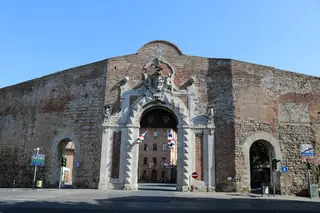
Porta Camollia

Selected as Siena’s northern threshold, where the Via Francigena brought pilgrims, merchants, and wealth while the walls faced the enduring threat from…

~10 min here·4 chapters
The Road That Made Siena RichFree chapter

Porta Camollia stood at the northern end of the Via Francigena, the great medieval pilgrimage road that funneled wealth, pilgrims, and merchants directly into Siena — and that traffic was the engine of everything the city became.

0:000:00
The Battle Fought at This GateFree chapter

In 1526, Florentine forces launched a surprise attack on the Camollia district just outside this gate, and the Sienese — citizens and soldiers together — repelled them in a single day, turning the site into a symbol of defiant independence.

0:000:00
How Siena Lost Its Independence

After a catastrophic 15-month siege in 1554–1555 that reduced the city's population from roughly 40,000 to fewer than 6,000, Siena surrendered on April 17, 1555, ending over 400 years of republican self-governance and passing into Medici control.
🔓
Unlock 1 more chapters in the app
Get the app
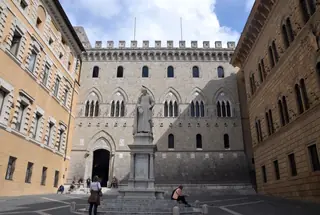
Piazza Salimbeni
02

Piazza Salimbeni

Selected as Siena’s financial heart, where merchant dynasties and Monte dei Paschi reveal how banking underwrote republican strength and social policy.

~15 min here·4 chapters
The Family That Carved Out Its Own Square

The Salimbeni family were international bankers who literally claimed a piece of Siena's urban fabric as their own fortified compound, and their name still defines this piazza 800 years later.

The Oldest Bank in the World, Born From Desperation

Monte dei Paschi di Siena was founded in 1472 by the Republic of Siena as a public institution to protect the poor from predatory moneylenders, making it the world's oldest surviving bank — and a direct expression of civic republican values.

When a Florentine Architect Came to Siena

Palazzo Spannocchi, built from 1473 by a papal banker using a Florentine Renaissance architect, introduced an entirely new architectural vocabulary into Siena's Gothic cityscape — and the three palazzi together span nearly three centuries of building history in one intimate square.

🔓
Unlock 1 more chapters in the app
Get the app
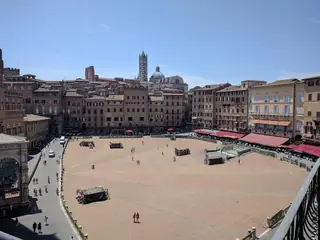
Piazza del Campo
03

Piazza del Campo

Selected because its nine-part shell design, civic gatherings, and living Palio traditions embody Siena’s government and neighborhood identity in a single…

~45 min here·3 chapters
How a Muddy Market Became a Civic Stage

The Piazza del Campo evolved over centuries from an uneven marketplace into one of medieval Europe's most deliberately designed civic spaces, shaped by the political ambitions of the Council of Nine.

The Fountain That Celebrated Running Water

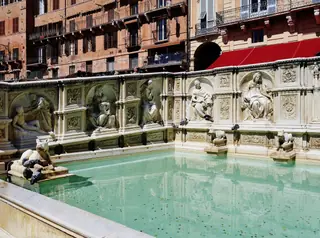
The Fonte Gaia was a monumental civic commission that fused Siena's remarkable underground aqueduct engineering with high Renaissance sculpture, turning a functional water source into a symbol of republican pride.

The Palio: 75 Seconds That Define a City

The Palio is not a tourist spectacle but a living expression of Siena's medieval contrada system — a deeply internal civic and religious ritual that has organized Sienese identity for centuries.

Fonte Gaia
04

Fonte Gaia

Selected because Fonte Gaia turns the hidden engineering of the bottini into a visible celebration of water, art, and communal provision.

~15 min here·3 chapters
Why Is a Fountain at the Top of a Slope?

The Fonte Gaia sits at the highest point of the Piazza del Campo — which seems physically impossible for a gravity-fed fountain — because Siena's medieval engineers built 25 kilometres of underground tunnels to deliver spring water uphill from outside the city.

The Sculptor Who Lost in Florence, Then Won in Siena

Jacopo della Quercia, who had just lost the famous Florence Baptistery doors competition to Ghiberti, channelled that defeat into an 11-year sculptural programme for the Fonte Gaia that became so influential Michelangelo studied it closely.

What Happened to the Original Marble

By the 19th century, 400 years of exposure had so severely eroded della Quercia's original reliefs that Siena replaced them with a faithful marble replica by sculptor Tito Sarrocchi, completed in 1868, while preserving the surviving original fragments indoors.

Palazzo Pubblico
05

Palazzo Pubblico

Selected as the republic’s governing center, where Ambrogio Lorenzetti’s Allegory of Good and Bad Government made the effects of political choices visible.

~15 min here·5 chapters
The Building the Nine Raised to Rule From

The Palazzo Pubblico was built from 1297 onward as a deliberate civic statement by Siena's ruling merchant oligarchy — the Council of Nine — to rival both Church authority and noble power.

The Tower That Measured a City's Day

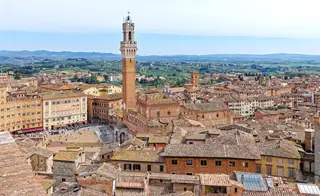
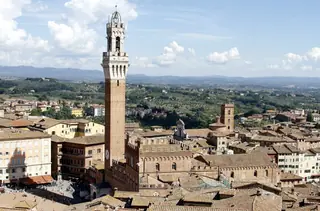
The Torre del Mangia — 102 meters tall, completed in 1348 — was built as a secular counterweight to church bell towers, with its bell regulating work, curfew, and civic time across the entire city.

Simone Martini's Virgin as Co-Ruler

Simone Martini's Maestà fresco (1315) — 7.6 meters wide — placed the Virgin Mary as a symbolic presiding figure over Sienese government, blurring the line between civic and religious authority in the council chamber itself.

🔓
Unlock 2 more chapters in the app
Get the app
Torre del Mangia
06

Torre del Mangia

Selected because its bells imposed civic time from above the Palazzo Pubblico, making secular authority both visible and audible beside the Cathedral’s power.

~10 min here·4 chapters
Two Visions Locked in One Tower

The Torre del Mangia was deliberately built as a secular counterweight to the Church's visual dominance, expressing Siena's conviction that civic government was the supreme power in the city.

The Bell-Ringer Who Named a Monument

The tower's popular name comes not from a ruler or patron but from its first bell-ringer, Giovanni di Lippo Luti, whose nickname "Mangia" — meaning roughly "eat-the-profits" — stuck so thoroughly that the commune eventually immortalized him in a mechanical statue.

The Voice of Civic Time — the Bell "Sunto"

The great bell "Sunto," cast in 1666 and weighing nearly 7 tonnes, was the literal timekeeper of the Sienese republic, and its ringing tied civic authority directly to the rhythm of daily life.

🔓
Unlock 1 more chapters in the app
Get the app
Siena Cathedral
07

Siena Cathedral

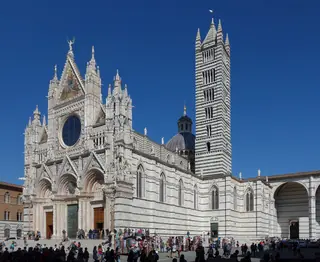
Selected as Siena’s marble declaration of religious and artistic ambition, from its striped exterior to its pavement and Piccolomini Library.

~15 min here·5 chapters
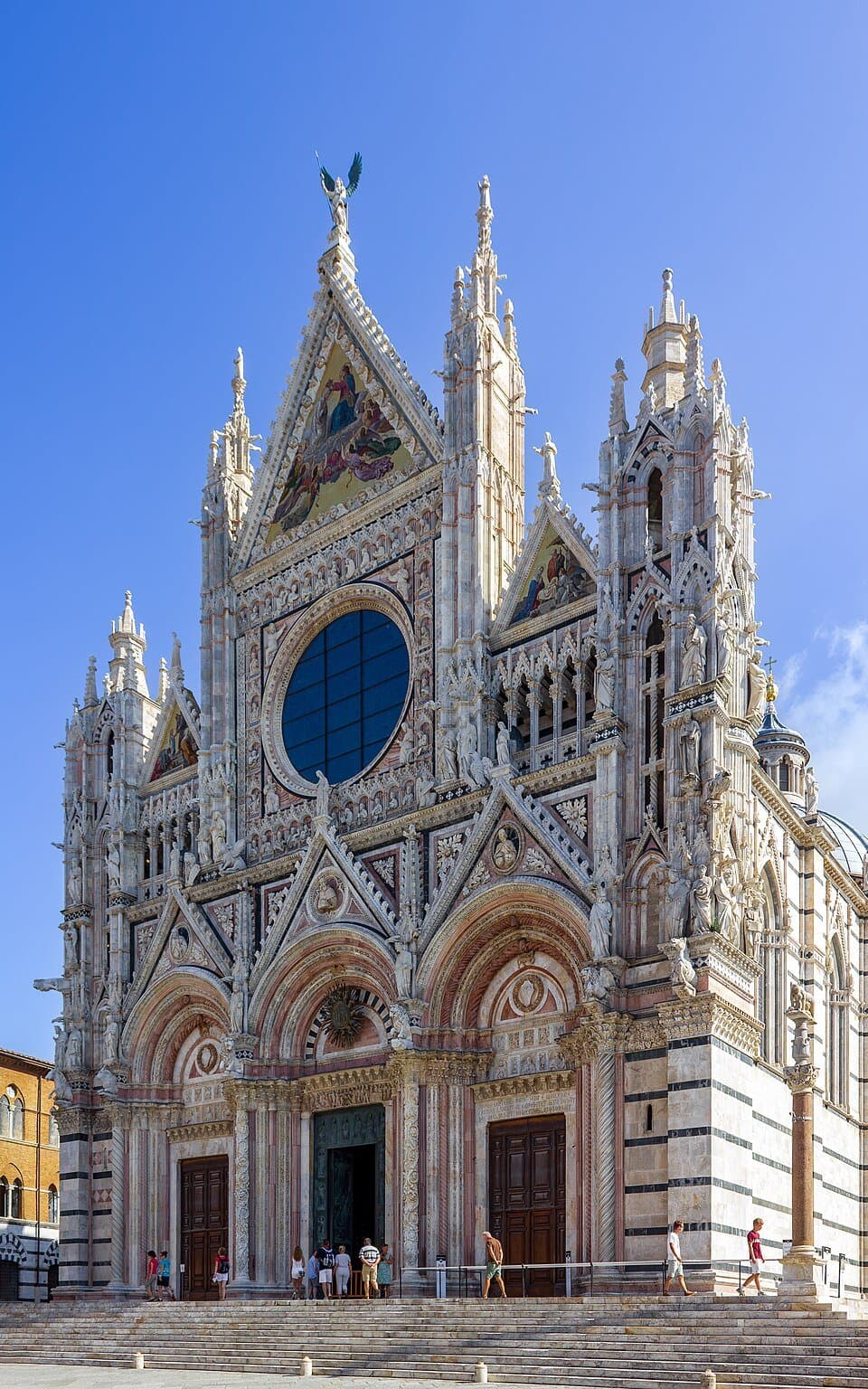
Giovanni Pisano and the Façade's Emotional Gamble

Giovanni Pisano designed the cathedral's lower façade with deliberate optical distortions — elongated necks, tilted heads — so figures carved at ground level would read correctly when seen from below, a calculated artistic innovation almost unknown in Italian sculpture before him.

Nicola Pisano's Pulpit and the Birth of a New Art

Nicola Pisano's octagonal pulpit inside the cathedral, completed in 1268 and supported by nine columns, is one of the landmark works of proto-Renaissance sculpture — more complex and emotionally charged than anything he'd made before, and created under one of the earliest surviving written sculptural contracts in Italian history.

The Floor Beneath Your Feet and Two Centuries of Craft

The cathedral's inlaid marble floor consists of 56 panels created by dozens of artists over roughly 178 years, from 1369 to 1547 — one of the most ambitious decorative programs in any medieval church, and mostly kept covered to protect it.

🔓
Unlock 2 more chapters in the app
Get the app
Facciatone and Duomo Nuovo
08

Facciatone and Duomo Nuovo

Selected as the surviving evidence of Siena’s boldest architectural gamble, halted by structural problems and the Black Death before the Duomo Nuovo could…

~10 min here·5 chapters
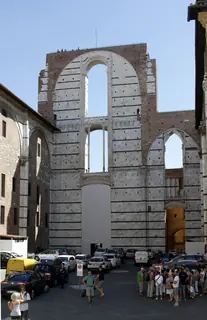
The Wall That Refuses to Explain Itself

The Facciatone is a 30-meter roofless brick wall — the unfinished facade of a cathedral nave that was never completed — and its raw, unadorned surface is a physical record of something that went catastrophically wrong.

The Architect Behind the Ambition

Giovanni di Agostino, appointed master builder of the Duomo Nuovo, oversaw the construction of the Facciatone and the nave walls — a project of a scale that had no precedent in Sienese building history.

What the Black Death Did to a Building

The Black Death of 1348 killed between one-third and one-half of Siena's population, instantly collapsing the workforce and finances needed to continue — halting construction permanently and leaving the Facciatone frozen mid-build.

🔓
Unlock 2 more chapters in the app
Get the app
Santa Maria della Scala
09

Santa Maria della Scala

Selected because this ancient hospital joined pilgrimage, medicine, foundling care, and public administration into a powerful expression of Siena’s civic…

~5 min here·5 chapters
The Building That Faces the Cathedral

Santa Maria della Scala was deliberately placed opposite the Cathedral as a statement that caring for the poor was as sacred as worship — and it eventually passed from Church to civic hands.

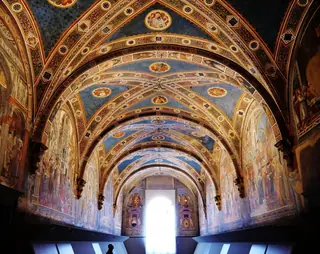
What the Walls Inside Actually Show

The Pellegrinaio frescoes, painted in the 1440s across a hall 51 meters long, are among the earliest detailed visual records of hospital life in Western art — and they were also deliberate civic propaganda.

The Children Nobody Claimed

Santa Maria della Scala ran one of the earliest documented foundling care systems in Europe, taking in abandoned infants and raising them — a practice that became central to its identity and its frescoes.

🔓
Unlock 2 more chapters in the app
Get the app
+ 2 more stops in the app

FAQ

How long does this route take?

The audio narration is 80:17 in total. If you pause to look around and take photos, budget 3 hrs. You can pause and resume any time — including the next day.

Is the tour narrated in my language?

This version is narrated in English by rrawi. Other language versions may be available — check the language switcher on this page.

Can I listen without an internet connection?

Yes. This self-guided audio tour works fully offline — download it in the rrawi app before you set off, and GPS automatically triggers the next chapter as you walk. No signal needed.

Do I have to start from the first stop?

No — you can start or jump to any stop in the app. The route works in order, but each stop stands on its own if you need to skip.

What does the free part include?

Different tours offer different free preview chapters depending on the content. Download the rrawi app and subscribe to a City Pass to unlock all 38 chapters and experience the full route.

Ready to walk Siena?

Download rrawi and let rrawi walk with you.

Walk with the app
First chapter at each stop is free
Get the app