HomeSan GimignanoHow Wealth Built San Gimignano’s Skyline
How Wealth Built San Gimignano’s Skyline
San Gimignano · Walking Tour

How Wealth Built San Gimignano’s Skyline

4 hrsWalk
0.6 kmDistance
8Stops
31Chapters

About this route

Imagine asking how a small hill town acquired a skyline of stone skyscrapers, then follow the money from pilgrims entering Porta San Giovanni, through the water, markets, and rival towers of Piazza della Cisterna, into the civic contest embodied by the Palazzo Comunale and Torre Grossa, before the Rocca di Montestaffoli reveals vineyards surrounding a town whose medieval skyline survived because Florence ordered a fortress above it in 1353.

🎧 Narrated audio tour⬇️ Works offline🌐 English📍 8 stops
Narrated by
rrawi
English

Stops on the route

8 stops · 31 chapters
Porta San Giovanni
01

Porta San Giovanni

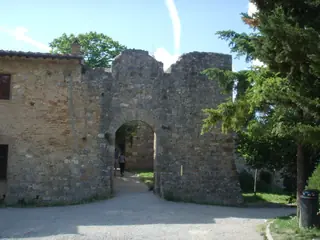
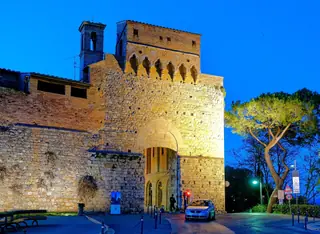
Porta San Giovanni introduces the fortified southern threshold where the commune monitored pilgrims, merchandise, and revenue entering from the Via Francigena.

~10 min here·3 chapters
What This Gate Was Built to ControlFree chapter

Porta San Giovanni was built in 1262 as a deliberately narrow, fortified threshold designed to funnel and control every person and every cart entering San Gimignano from the south.

0:000:00
The Pilgrimage Road That Built a TownFree chapter

San Gimignano's position on the Via Francigena transformed it from a hilltop village into a prosperous commercial hub, with Via San Giovanni — the street directly ahead — functioning as the commercial spine that captured pilgrim spending.

0:000:00
The Sienese Coat of Arms Above the Arch

The Balzana — Siena's black-and-white heraldic symbol — visible on the gate records the moment in 1353 when San Gimignano surrendered its independence, a defeat driven by plague, factional conflict, and economic decline.
Via San Giovanni and Via Francigena
02

Via San Giovanni and Via Francigena

Via San Giovanni demonstrates how pilgrims, merchants, inns, hospitals, saffron, and Vernaccia wine turned an international route into the economic engine…

~20 min here·4 chapters
The Street That Shouldn't Be This Straight

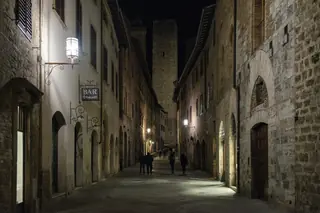
Via San Giovanni's unusually straight layout was no accident — it was engineered to funnel pilgrims and their money directly through the commercial heart of San Gimignano.

The Archbishop Who Put San Gimignano on the Map

A single document written by an Anglo-Saxon archbishop in 990 AD is the oldest surviving proof that San Gimignano stood on the Via Francigena — and it's still the reference used to certify the route today.

What Pilgrims Actually Bought on This Street

The pilgrim traffic on Via San Giovanni sustained a dense economy of inns, money-changers, apothecaries, and merchants dealing in saffron and Vernaccia wine — transforming San Gimignano into one of the wealthiest small communes in Tuscany.

🔓
Unlock 1 more chapters in the app
Get the app
Piazza della Cisterna
03

Piazza della Cisterna

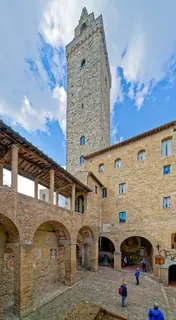
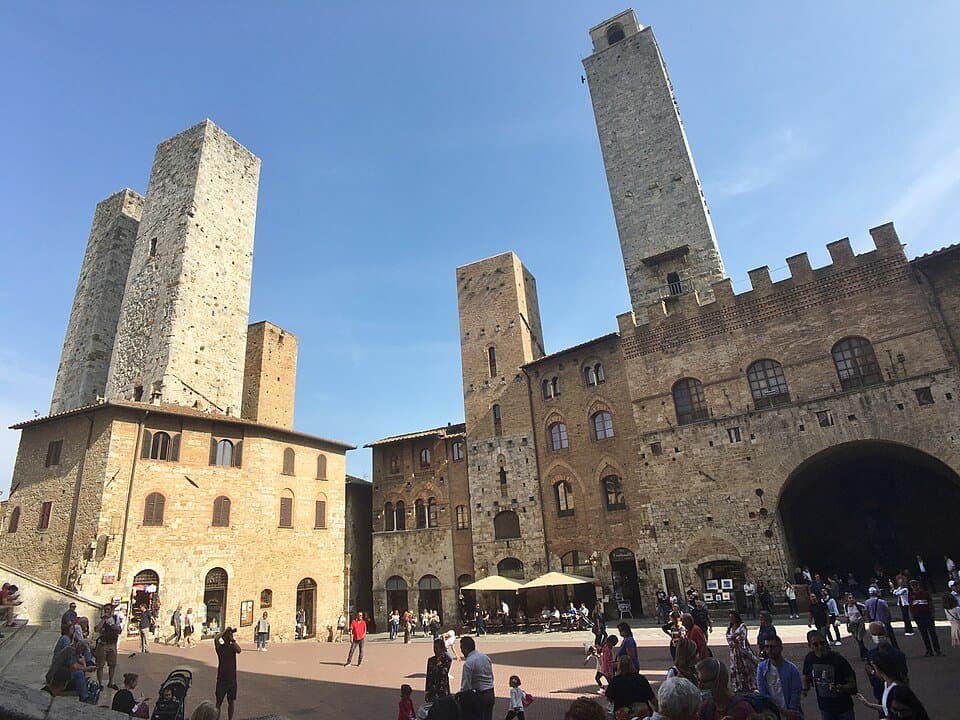
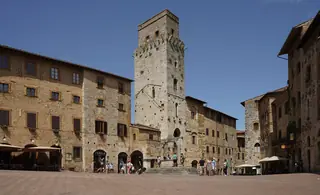
Piazza della Cisterna connects public water collection and everyday commerce with the houses and towers through which rival families displayed their wealth.

~20 min here·4 chapters
The Octagonal Well at the Square's Heart

The cistern was built in 1237 as a communal water solution for a town flooded with pilgrims and merchants, and it gave the piazza its name and identity.

How Towers Became a Family's Social Media

The towers surrounding the piazza were built by rival noble families as simultaneous military assets and status symbols, with height directly equating to power and prestige.

What the Herringbone Paving Actually Signals

The 1346 herringbone brick paving was a deliberate civic investment that transformed the piazza into a formal public space, signaling the commune's prosperity and ambition.

🔓
Unlock 1 more chapters in the app
Get the app
Piazza del Duomo
04

Piazza del Duomo

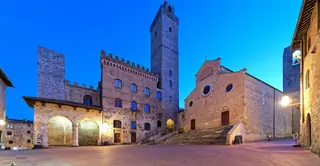
Piazza del Duomo brings church, communal government, elite residences, and public space into one visible contest over who possessed authority in medieval San…

~45 min here·3 chapters
Two Powers, One Square

Piazza del Duomo was shaped by two competing forces — the Church and the commune — each staking a claim on the same ground, and the square's layout still maps that tension.

The Church That Outgrew Its Status

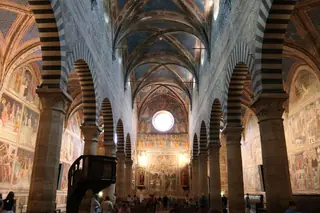
The Collegiata was consecrated in 1148 as a collegiate church — a deliberate mark of prestige just below a cathedral — and its plain exterior conceals one of the densest fresco cycles in Tuscany, funded by a town that needed to impress pilgrims passing through on the Via Francigena.

The Commune Versus the Clans

The Palazzo del Popolo and its Torre Grossa were built to assert civic authority over feuding noble families — and a law capping all private towers below 54 meters turned the commune's own tower into a literal symbol of supremacy.

Collegiata di Santa Maria Assunta
05

Collegiata di Santa Maria Assunta

The Collegiata di Santa Maria Assunta reveals how civic wealth, pilgrimage, and religious ambition funded extraordinary biblical fresco cycles despite the…

~45 min here·4 chapters
Why This Church Has No Cathedral Title

The Collegiata is not a cathedral but a collegiate church — a distinction that tells you everything about San Gimignano's peculiar ambition and its place on the pilgrimage map.

The Bible in Paint, Wall to Wall

The interior walls are covered in two monumental fresco cycles — Old Testament on the left, New Testament on the right — functioning as a visual Bible for a largely illiterate medieval audience.

Father and Son, Separated by Decades

The Last Judgment fresco on the west wall was painted by Taddeo di Bartolo in 1393 — the son of the man who painted the Old Testament cycle on the opposite wall, making the Collegiata a family project spanning generations.

🔓
Unlock 1 more chapters in the app
Get the app
Palazzo Comunale
06

Palazzo Comunale

The Palazzo Comunale shows how San Gimignano’s government used architecture, regulation, and civic art to assert collective authority over powerful…

~1 hr here·5 chapters
The Puzzle Behind the Palace's Front Door

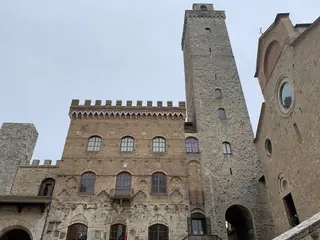
The Palazzo Comunale was built as a deliberate assertion of collective civic authority over the powerful private families who were busy building towers all around it.

The Virgin Mary in the Council Chamber

Lippo Memmi's 1317 Maestà fresco turned the council hall into a space of sacred civic authority, using the visual language of Siena to project San Gimignano's political ambitions.

The Day Dante Walked Through That Door

In May 1300, Dante Alighieri addressed San Gimignano's governing council in this building as a Florentine ambassador — one of the last acts of his political career before his permanent exile.

🔓
Unlock 2 more chapters in the app
Get the app
Torre Grossa
07

Torre Grossa

The 54-meter Torre Grossa makes civic height regulations, surveillance, and prestige tangible while clarifying that San Gimignano’s towers were status symbols…

~30 min here·4 chapters
The Man Who Built Above Everyone Else

The Torre Grossa was built by San Gimignano's commune — not a noble family — as a deliberate act of civic supremacy, rising 54 meters and attaching itself physically to the seat of government.

The Law That Froze the Tower Race

The commune passed a law making 54 meters the absolute legal ceiling for all private towers in San Gimignano — a height regulation ordinance that is one of the earliest known in medieval history.

What Towers Actually Did — and Didn't Do

Towers served primarily as symbols of wealth and political status; their military function was real but secondary, and the "medieval Manhattan" image overstates the purely defensive role.

🔓
Unlock 1 more chapters in the app
Get the app
Rocca di Montestaffoli
08

Rocca di Montestaffoli

The Rocca di Montestaffoli provides the final connection between Florentine control, San Gimignano’s lost independence, its preserved skyline, and the…

~30 min here·4 chapters
The Day San Gimignano Stopped Being Itself

On May 8, 1353, San Gimignano formally surrendered its independence to Florence — and Florence's first act was to build this fortress on the town's own highest hill, turning civic pride into an instrument of occupation.

What Broke a Prosperous Commune

The Black Death of 1348 devastated San Gimignano's population and shattered its economic capacity, making Florentine submission five years later almost inevitable.

The View Florence Wanted to Own

The Rocca sits on the highest point in San Gimignano, and the surviving tower offers the panoramic vantage point over the Val d'Elsa that made this hill strategically critical for centuries.

🔓
Unlock 1 more chapters in the app
Get the app
+ 1 more stops in the app

FAQ

How long does this route take?

The audio narration is 60:47 in total. If you pause to look around and take photos, budget 4 hrs. You can pause and resume any time — including the next day.

Is the tour narrated in my language?

This version is narrated in English by rrawi. Other language versions may be available — check the language switcher on this page.

Can I listen without an internet connection?

Yes. This self-guided audio tour works fully offline — download it in the rrawi app before you set off, and GPS automatically triggers the next chapter as you walk. No signal needed.

Do I have to start from the first stop?

No — you can start or jump to any stop in the app. The route works in order, but each stop stands on its own if you need to skip.

What does the free part include?

Different tours offer different free preview chapters depending on the content. Download the rrawi app and subscribe to a City Pass to unlock all 31 chapters and experience the full route.

Ready to walk San Gimignano?

Download rrawi and let rrawi walk with you.

Walk with the app
First chapter at each stop is free
Get the app