HomeMontepulcianoMontepulciano: Power Along the Ridge
Montepulciano: Power Along the Ridge
Montepulciano · Walking Tour

Montepulciano: Power Along the Ridge

4 hrsWalk
1.3 kmDistance
9Stops
35Chapters

About this route

Imagine how a small ridge town made itself impossible to overlook, climbing from the Florentine claim at Porta al Prato through the wine economy beneath Cantina De' Ricci and the ceremonial theater of Piazza Grande to San Biagio, where Montepulciano set a travertine dome against the open valley.

🎧 Narrated audio tour⬇️ Works offline🌐 English📍 9 stops
Narrated by
rrawi
English

Stops on the route

9 stops · 35 chapters
Porta al Prato
01

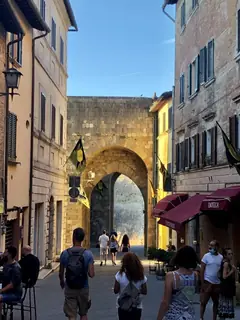
Porta al Prato

The fortified northern gate introduces Montepulciano’s steep urban axis and the strategic geography that made the ridge valuable to both Siena and Florence.

~10 min here·4 chapters
The Gate That Controls the RidgeFree chapter

Porta al Prato's position at the base of Montepulciano's narrow volcanic ridge made it the single military and commercial chokepoint for the entire town — whoever held this gate held the town.

0:000:00
A Stone Lion as Political BroadcastFree chapter

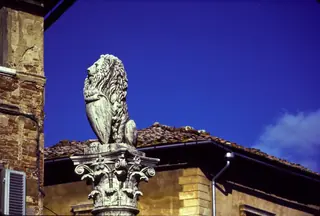
The Marzocco column — the Florentine heraldic lion erected at this gate in 1511 — was a deliberate act of political branding, replacing Sienese symbolism and announcing Florentine sovereignty to every person who entered or left the town.

0:000:00
Cosimo I and the Medici Coat of Arms

The Medici coat of arms on Porta al Prato connects the gate specifically to Cosimo I de' Medici, who used heraldic markings on civic structures across Tuscany as a systematic assertion of personal sovereignty over subject towns.
🔓
Unlock 1 more chapters in the app
Get the app
Colonna del Marzocco
02

Colonna del Marzocco

The Florentine lion installed in 1511 makes political allegiance visible, showing how a public emblem could announce control over the contested ridge town.

~10 min here·4 chapters
What Stood Here Before the Lion

Montepulciano spent centuries caught between Siena and Florence before definitively choosing a side, and this column marks the exact moment that choice became permanent stone.

How Florence Planted Its Flag in Stone

The Marzocco column erected in 1511 was a deliberate, calculated act of Florentine political theatre — a permanent public declaration of sovereignty designed to be seen by everyone entering the town.

The Most Famous Lion Florence Ever Made

The Marzocco symbol had a celebrated artistic history in Florence itself — Donatello's version is a landmark of early Renaissance sculpture — which made erecting one in a subject town all the more loaded with meaning.

🔓
Unlock 1 more chapters in the app
Get the app
Torre di Pulcinella
03

Torre di Pulcinella

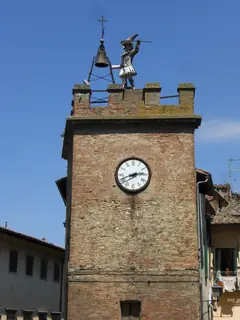
The bell-striking Pulcinella combines civic timekeeping with a Neapolitan theatrical figure, revealing how an imported cultural symbol entered Montepulciano’s…

~10 min here·3 chapters
The White Figure Striking the Bell

The Torre di Pulcinella is a medieval stone tower topped by a mechanical white figure of the commedia dell'arte character Pulcinella, who strikes a large bell to mark the hours — an unusual fusion of civic timekeeping and theatrical popular culture.

How a Neapolitan Trickster Crossed Italy

Pulcinella originated in Neapolitan commedia dell'arte as a subversive, cunning clown, and his image spread across Europe through theatrical performance — eventually giving rise to England's Mr. Punch and France's Polichinelle, making him one of the most widely traveled cultural figures of the early modern period.

Civic Time and the Town's Daily Rhythm

The tower's mechanical bell-striking function served a concrete civic purpose — regulating daily life on the Corso — and Pulcinella's position at the top of the main street made him the symbolic anchor of Montepulciano's public life, a role he still holds today.

Cantina De' Ricci
04

Cantina De' Ricci

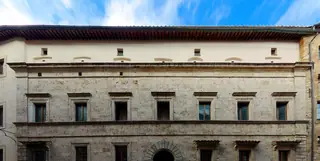
This Renaissance palazzo and its deep cellars reveal how noble status above ground depended on vineyards, aging barrels, and the trade in Vino Nobile below.

~45 min here·3 chapters
The Palace Above and the Cellar Below

Cantina De' Ricci reveals how Montepulciano's noble families built their power on two levels simultaneously — a Renaissance facade projecting status on the street, and a working agricultural infrastructure carved 60 meters into the volcanic tufa beneath it.

What "Noble" Actually Meant in a Wine Name

The name Vino Nobile di Montepulciano carries a 400-year paper trail of prestige, rooted in the literal association between noble families — like the De' Ricci — who aged wine in palace cellars, and the wine itself being considered fit only for aristocratic tables.

The Barrels, the Time, and the Trade

The large Slavonian oak barrels lining the cellar walls are not decorative — they are the specific technology through which Vino Nobile acquires its character, and they represent the connection between the town's elite families and the agricultural landscape surrounding the ridge.

Palazzo Comunale
05

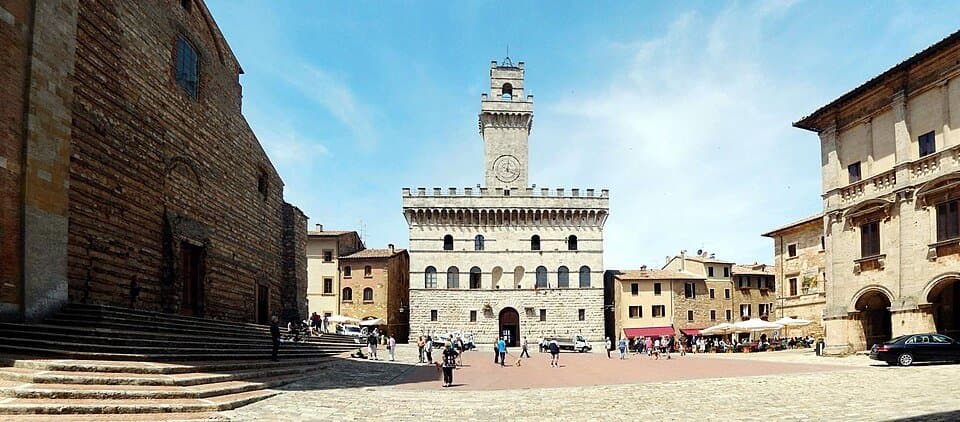
Palazzo Comunale

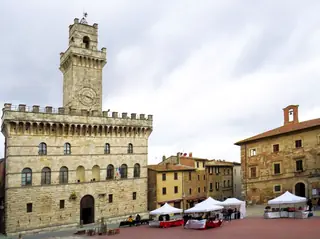
Michelozzo’s Florentine-inspired town hall shows communal government using architecture and its commanding tower to associate Montepulciano with the power of…

~30 min here·4 chapters
Why This Town Hall Looks Like Florence

The Palazzo Comunale was deliberately remodeled to echo Florence's Palazzo Vecchio, a physical declaration of political allegiance built in stone.

The Architect Who Carried Florence in His Blueprints

Michelozzo di Bartolomeo, the Medici's favored architect, designed the tower and contributed to the façade, physically transplanting Florentine Renaissance architecture into Montepulciano.

Reading the Medici Coat of Arms on the Wall

The Medici coat of arms and a clock on the exterior mark the period of Florentine and Medici rule, embedding political control into the most public face of civic government.

🔓
Unlock 1 more chapters in the app
Get the app
Montepulciano Cathedral
06

Montepulciano Cathedral

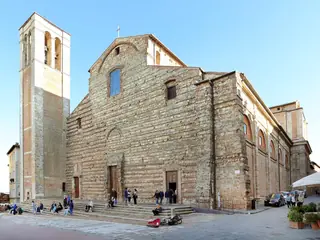
The cathedral’s unfinished façade, inherited medieval artworks, and long civic construction campaign expose both the scale and the limits of Montepulciano’s…

~30 min here·5 chapters
The Medieval Church That Stood Here First

A medieval church of Santa Maria occupied this site before the current cathedral, and its demolition in 1592 marked a deliberate act of civic reinvention.

Eighty-Eight Years of Building — and One Unfinished Wall

The cathedral took 88 years to complete, from 1592 to 1680, and its façade was never clad in stone — leaving bare brick that tells the honest story of a small town's reach exceeding its grasp.

Taddeo di Bartolo's Altarpiece, Saved From the Old Church

The cathedral's most important painting — a nearly 3-meter-tall Sienese Gothic altarpiece from 1401 — survived the demolition of the medieval church and was preserved into the new building.

🔓
Unlock 2 more chapters in the app
Get the app
Piazza Grande
07

Piazza Grande

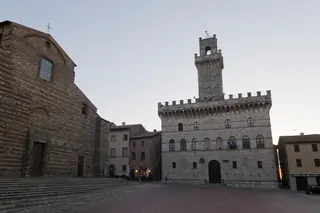
At the ridge’s ceremonial summit, civic buildings, religious authority, Renaissance design, and the Bravio delle Botti converge on the town’s principal public…

~30 min here·5 chapters
The Medieval Square Before the Renaissance Arrived

Piazza Grande began as a medieval hilltop gathering point that was progressively shaped by civic ambition over several centuries before its Renaissance face emerged.

A Sienese Painter in a Town Turning Florentine

In 1401, Montepulciano commissioned a major altarpiece from the Sienese painter Taddeo di Bartolo — a cultural statement made at the exact moment the town's political allegiance was shifting toward Florence.

How Sangallo Gave the Piazza Its Renaissance Frame

Antonio da Sangallo the Elder shaped the Renaissance character of Piazza Grande through his design of the Palazzo Nobili-Tarugi, giving the square its most architecturally refined civic building.

🔓
Unlock 2 more chapters in the app
Get the app
Pozzo dei Grifi e dei Leoni
08

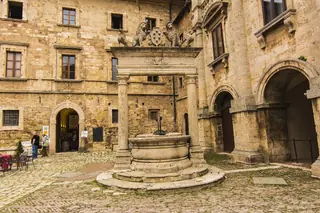
Pozzo dei Grifi e dei Leoni

Antonio da Sangallo the Elder’s well turns essential water infrastructure into a heraldic display pairing Montepulciano’s griffins with Medici lions.

~10 min here·3 chapters
A Hilltop Town's Most Urgent Problem

Montepulciano's hilltop position made it militarily strong but chronically water-starved, which is why a monumental public well at the heart of Piazza Grande was not a luxury — it was a necessity.

What the Carvings on a Well Actually Mean

The Pozzo dei Grifi e dei Leoni is a piece of political infrastructure — its carved heraldry publicly declared Montepulciano's allegiance to Florence and the Medici at the moment you came to draw water.

The Architect Behind the Stone

Antonio da Sangallo the Elder — the same Florentine architect building San Biagio just outside the town walls — designed this well, making him the defining architectural voice of Montepulciano's Renaissance ambitions.

San Biagio
09

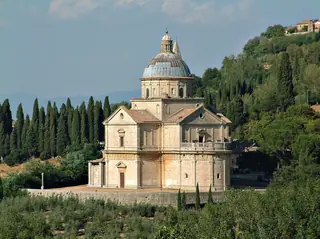
San Biagio

Antonio da Sangallo the Elder’s centralized travertine church provides the tour’s architectural culmination, contrasting geometric calm outside the walls with…

~30 min here·4 chapters
Two Men, One Church, One Unfinished Tower

San Biagio was conceived through two very different visions — a miraculous popular apparition that galvanized an entire town, and one architect's consuming, lifelong ambition to build a perfect Renaissance temple.

The Architecture of a Perfect Idea

San Biagio's Greek-cross plan, travertine construction, and isolated siting were deliberate humanist statements — a Renaissance vision of sacred geometry made physical.

What the Unfinished Tower Actually Tells You

Antonio da Sangallo the Elder's death in 1534 left San Biagio permanently incomplete, and the visible stub of the second campanile is a direct record of that moment — the point where one man's vision ran out of time.

🔓
Unlock 1 more chapters in the app
Get the app
+ 2 more stops in the app

FAQ

How long does this route take?

The audio narration is 70:29 in total. If you pause to look around and take photos, budget 4 hrs. You can pause and resume any time — including the next day.

Is the tour narrated in my language?

This version is narrated in English by rrawi. Other language versions may be available — check the language switcher on this page.

Can I listen without an internet connection?

Yes. This self-guided audio tour works fully offline — download it in the rrawi app before you set off, and GPS automatically triggers the next chapter as you walk. No signal needed.

Do I have to start from the first stop?

No — you can start or jump to any stop in the app. The route works in order, but each stop stands on its own if you need to skip.

What does the free part include?

Different tours offer different free preview chapters depending on the content. Download the rrawi app and subscribe to a City Pass to unlock all 35 chapters and experience the full route.

Ready to walk Montepulciano?

Download rrawi and let rrawi walk with you.

Walk with the app
First chapter at each stop is free
Get the app