Tuttomondo
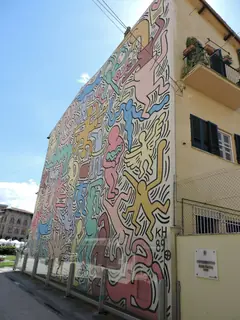
Keith Haring painted Tuttomondo in June 1989 after a chance encounter with a Pisan student in New York, creating thirty interlocking figures that form a continuous, puzzle-like surface celebrating cooperation and peace.

Imagine discovering the city hidden behind its famous tilt, from Keith Haring’s interlocking figures at Tuttomondo through the Arno commerce visible at Ponte di Mezzo and the conquered civic stage of Piazza dei Cavalieri to Piazza del Duomo, where a maritime republic’s coordinated marble ensemble culminates in the bell tower engineers stabilized by reducing its lean about 44 centimeters.
Keith Haring painted Tuttomondo in June 1989 after a chance encounter with a Pisan student in New York, creating thirty interlocking figures that form a continuous, puzzle-like surface celebrating cooperation and peace.
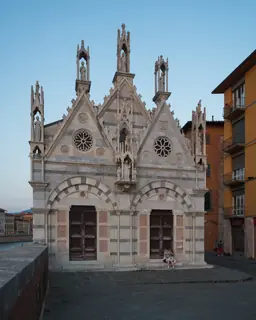
Santa Maria della Spina began as a tiny riverside oratory and was transformed in the 14th century into an astonishing concentration of Gothic sculpture and marble inlay — all to house a single thorn said to be from Christ's Crown of Thorns.
The church's original position directly on the Arno embankment connected it to Pisa's commercial and maritime identity — but that same river repeatedly threatened to destroy it, eventually forcing a 19th-century engineering intervention that dismantled and raised the entire structure.
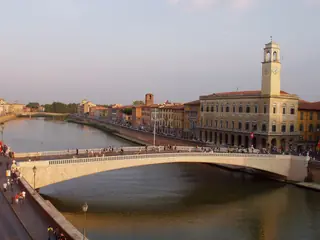
The Arno River is not just a backdrop — it is the physical and commercial spine that Pisa was built around, visible from the bridge as a continuous panorama of palaces, churches, and history.
The bridge at this site has been destroyed and rebuilt multiple times across its history, with the current single-arch structure dating to 1950 after wartime destruction.
The Gioco del Ponte is a ritual contest that transforms the bridge into an arena, pitting Pisa's northern and southern quarters against each other in a push-of-war that keeps the city's old rivalries alive.
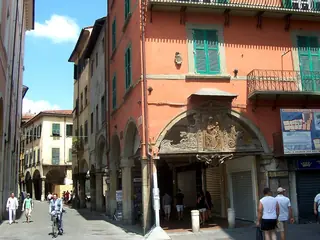
Piazza Garibaldi and Borgo Stretto grew directly out of Pisa's dependence on the Arno — the bridge crossing fed commercial traffic northward through this exact corridor.
Borgo Stretto's continuous medieval arcades conceal the remnants of wealthy family tower houses — the street's proportions and fabric are far older than its shopfronts suggest.
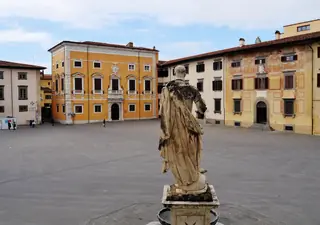
Piazza dei Cavalieri was once the beating political heart of the independent Pisan commune, then deliberately remade to erase that identity.
Cosimo I commissioned Giorgio Vasari in 1558 to transform the square into a showcase of Medici power, centered on a new chivalric order with Mediterranean ambitions.
The Torre della Gherardesca on the square's edge is where Count Ugolino was imprisoned — an episode so brutal that Dante made it one of the most harrowing passages in the entire Commedia.
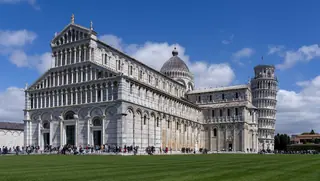
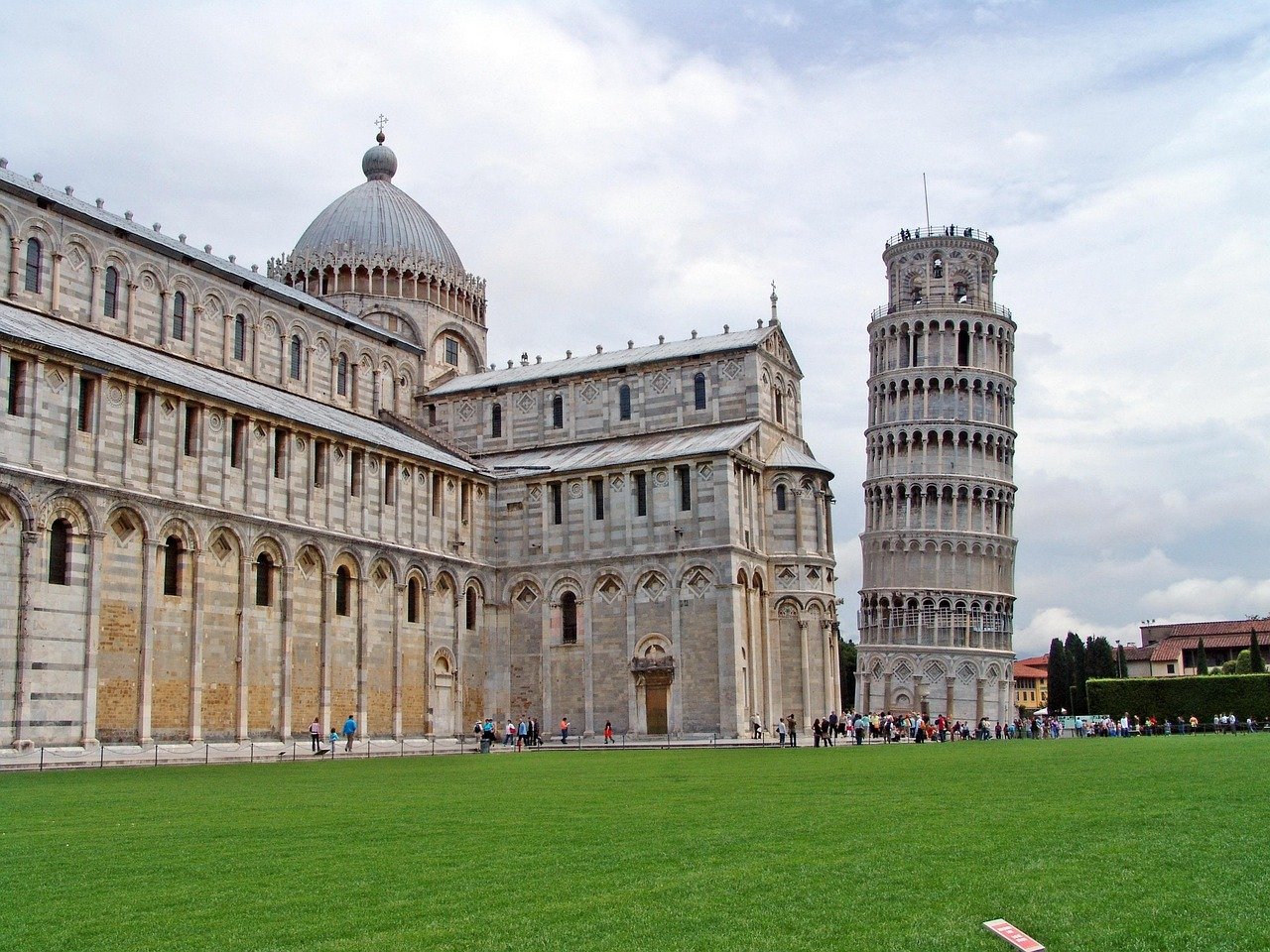
The Piazza del Duomo was built not as a tourist attraction but as a deliberate statement of civic and maritime power by a republic that competed with the greatest cities in the Mediterranean world.
Pisan Romanesque architecture absorbed influences from across the Mediterranean — Islamic geometric patterns, Byzantine marble techniques, classical Roman forms — because Pisa's merchant fleets physically brought those worlds into contact.
The four monuments together — Cathedral, Baptistery, bell tower, and Camposanto — formed a complete civic and religious program that covered birth, worship, death, and the summoning of the faithful, projecting Pisa's identity as a republic that answered to God and no one else.
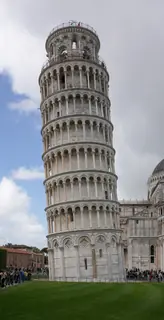
The Leaning Tower is the cathedral's campanile — one piece of a coordinated ensemble built by a maritime republic at the height of its power — not a freestanding novelty.
The tilt began almost immediately due to soft alluvial soil, and successive builders over two centuries responded by curving the upper levels to compensate — making the tower a record of its own troubled construction.
A stabilization campaign completed in 2001 reduced the lean by about 44 centimeters and reopened the tower — preserving both the structure and its historic tilt.
The audio narration is 35:45 in total. If you pause to look around and take photos, budget 2 hrs. You can pause and resume any time — including the next day.
This version is narrated in English by rrawi. Other language versions may be available — check the language switcher on this page.
Yes. This self-guided audio tour works fully offline — download it in the rrawi app before you set off, and GPS automatically triggers the next chapter as you walk. No signal needed.
No — you can start or jump to any stop in the app. The route works in order, but each stop stands on its own if you need to skip.
Different tours offer different free preview chapters depending on the content. Download the rrawi app and purchase the tour to unlock all 18 chapters and experience the full route.
Download rrawi and let rrawi walk with you.